Always be aware that MAXAIR® Filters are designed for airborne particulates only. MAXAIR® Filters are not intended for use in environments where gases or vapors must be filtered.
MAXAIR® Cuff and Shroud Systems use individual Filter Caps and Filter Cartridges, while Hood Systems use a filter integrated into the top of the Hood.
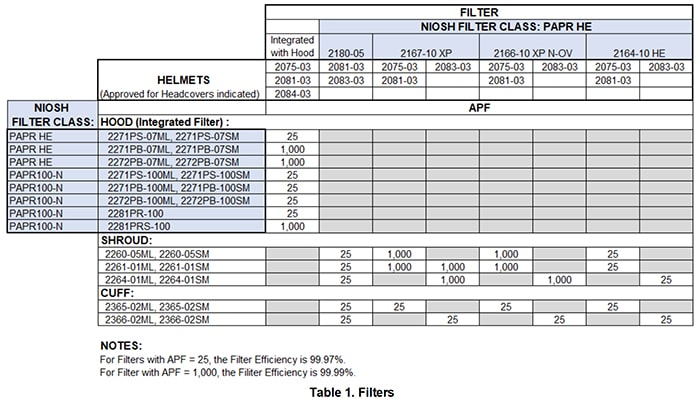
MAXAIR® CAPR® System Filters are classified by NIOSH as either PAPR HE or PAPR100-N. Table 1 below shows the different filters, their NIOSH classifications, APFs, and related minimum filter efficiencies.
Cuff and Shroud Systems – Filter Cartridges
The 2180-05 HE Filter Cap is MAXAIR®’s most recent filter innovation for Cuff and Shroud Systems. This filter provides an OSHA¹ APF of 25, NIOSH HE-level particulate filtration efficiency, and silica dust-loading capacity at a very low cost.
The 2167-10 XP and 2166-10 XP N-OV Filter Cartridges are convenient snap-on/snap-off filters for use with MAXAIR® CAPR® Cuff and Shroud System configurations.
When used with Cuff Systems, they provide an APF of 25 per OSHA.¹
When used with Shroud Systems, they meet OSHA requirements for an APF of 1,000 based on our engineering test data.
The 2166-10 XP N-OV Filter Cartridge also provides relief from nuisance levels² of organic vapors when used with both Shroud and Cuff Systems.
¹ https://www.osha.gov/sites/default/files/publications/3352-APF-respirators.pdf, Page 14, Table 1, Note 4
² Levels below the OSHA PEL, typically 5%–10% of the OSHA PEL.
Both Filter Cartridges are also classified as PAPR HE and pass NIOSH silica dust-loading testing.
Hood System Filters
CAPR® Hoods have a filter integrated into the top of the Hood. Depending on the filter, as shown in Table 1 above, it is classified as either PAPR HE or PAPR100-N.
Class HE Hoods include a NIOSH-required HLF (Heavy Loading Filter).
All MAXAIR® Hoods may be worn with an optional High Fluid Resistant Filter Cover Cap for maximum fluid protection of the filter area.
PAPR HE and PAPR100 classifications are primarily determined by filter capabilities, as indicated in the table above.
In general, MAXAIR® System filters are not intended to be exposed to water.
If water spray is possible, we recommend using:
A Shroud configuration with a Filter Cover Cap (FCC) to help protect the Filter Cartridge.
A Hood configuration with an HFR FCC (High Fluid Resistance Filter Cover Cap) to help protect the Hood Filter.
If a filter becomes wet from non-toxic, otherwise non-harmful material, it should be allowed to dry thoroughly before its next use.
Note: All Head and Face Covers are designed for single use. Hoods, which include integrated filters, are also single-use Head Covers.
Filter replacement depends on the application, the environment in which the system is used, the frequency and duration of use, and the organization’s protocol for preventing cross-contamination.
Regardless, the MAXAIR® CAPR® System’s yellow LED provides a self-monitoring function that helps account for these variables. The yellow LED will illuminate when airflow intake begins to become restricted and approaches the 6 cfm (170 lpm) threshold. This visual warning provides the user with time to exit the work environment and replace a heavily loaded filter.
Otherwise, we recommend replacing the filter at least every six to twelve months.
When illuminated, the yellow LED indicates a low-airflow condition. If it illuminates during use, the system is approaching a point where it may no longer be able to maintain the desired airflow. At this time, the filter should be checked to determine whether replacement is necessary.
The three green LEDs, together with the red LED, provide a general indication of the battery’s remaining charge:
Three green LEDs: Approximately 75%–100% charge remaining
Two green LEDs: Approximately 50%–75% charge remaining
One green LED: Approximately 25%–50% charge remaining. At this point, the user should plan to recharge or replace the battery at the next opportunity.
No green LEDs and one red LED: Approximately 0%–25% charge remaining. The user should replace or recharge the battery as soon as possible.
If both the red and yellow LEDs are illuminated, both the battery and filter should be checked and replaced as necessary.
In a typical healthcare environment, the yellow LED should rarely illuminate because these environments generally have lower particulate loading compared with many industrial applications.
There are no procedures for cleaning MAXAIR® Filters for reuse. Once a filter becomes loaded to the point that the Helmet’s yellow LED illuminates, or after 6–12 months of use, whichever occurs first, the MAXAIR® Filter should be discarded in accordance with institutional policies and local regulatory requirements.
Most users prefer the Cuff System configuration for infection control in patient care areas because it more conveniently accommodates stethoscope use.
Cuff configurations are the primary choice in environments where contact and fluid contamination are not major concerns, as the neck and the sides and back of the head remain exposed.
Shroud configurations are usually recommended over Cuff configurations when:
More complete, 360° contact and fluid protection is needed or desired.
It is acceptable and desirable to reuse the filter multiple times. This also applies to Cuff configurations, but not to Hood configurations.
Hood configurations are typically the preferred choice when the maximum protection of a Shroud is needed or desired and when disposal of the entire Head Cover and integrated filter is acceptable and economical.
Both Shroud and Hood configurations are available in single- and double-shroud styles:
The outer shroud is typically worn outside the outer body gown to help protect against splash.
The inner shroud in double-shroud and double-hood configurations is worn inside the body gown and provides:
An improved airborne contaminant seal.
A filtered-air escape mechanism.
MAXAIR® Cuff and Shroud configurations use a separate, independently installed Filter Cap or Filter Cartridge: the 2180-05 Filter Cap, 2167-10 XP Filter Cartridge, or 2166-10 XP N-OV Filter Cartridge. All MAXAIR® Hoods have a filter integrated into the top of the Hood.
The XP designation indicates that the filter meets NIOSH HE requirements for PAPR filtration, including passing the Silica Dust Loading Test.
The N-OV designation of the 2166-10 XP N-OV Filter Cartridge indicates that it also provides relief from nuisance levels of organic vapors when used with CAPR® Shrouds. Nuisance levels are below the OSHA PEL, typically 5%–10% of the OSHA PEL.
Additional considerations when selecting a configuration include:
Cuff Configurations
Cuff configurations are typically preferred when full 360° head, contact, and fluid protection is not required, as the neck and the sides and back of the head remain exposed.
Shroud Configurations
Shroud configurations are typically recommended over Cuff configurations when:
Greater contact and fluid protection is needed.
It is acceptable and desirable to use the Filter multiple times.
Hood Configurations
Hood configurations are typically preferred when the more complete protection of a Shroud is needed or desired and when disposal of the entire Head Cover and integrated Filter is acceptable and economical.
Both Shroud and Hood configurations are available in single- and double-shroud styles:
The outer shroud is typically worn outside the outer body gown to help protect against splash.
The inner shroud of double-shroud and double-hood configurations is worn inside the body gown and provides:
An improved airborne contaminant seal.
A filtered-air escape mechanism.